Now this is some crazy stuff! How about a wah / ringmodulator with vibrato tails???
The schematic is avaiable at DeadEnd Fx.
Note that the Wah/Cosmo Select switch is the stock 2P6T rotary for this layout.
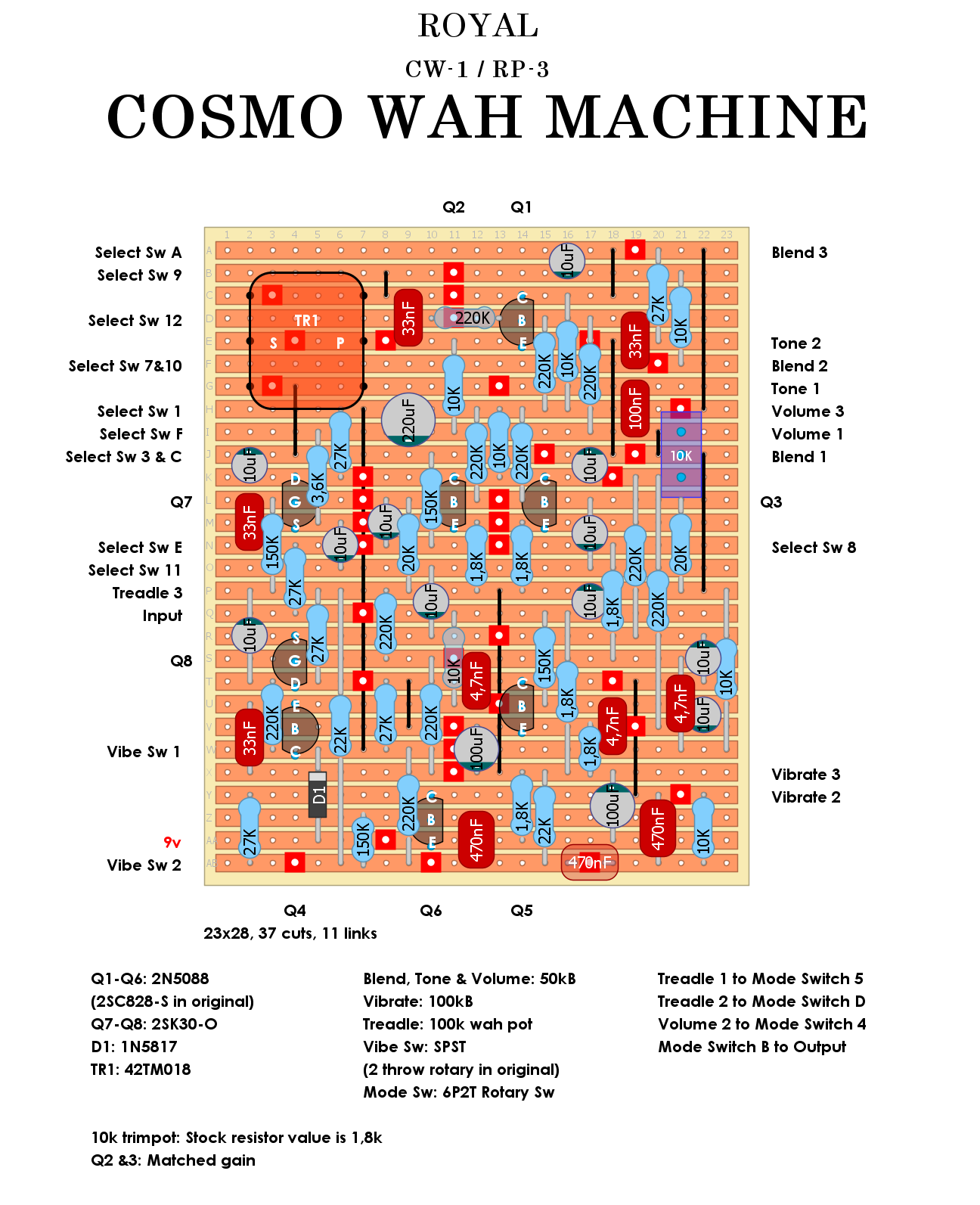
Now this is some crazy stuff! How about a wah / ringmodulator with vibrato tails???
The schematic is avaiable at DeadEnd Fx.
Note that the Wah/Cosmo Select switch is the stock 2P6T rotary for this layout.
Another old japanese obscurity. There is a hand drawn factory schematic floating on the web but I decided to clean it up in order to build a clone. It looked like slimmed down Ibanez Standard Fuzz with a tone control. and a "Howl Adjust" control which dials in the upper octave.
And built the fuzz section only...and it wasn't any good...at all. Lacking in gain, output volume and the tone control was useless. So I had to mod it without tinkering too much Added a "gain cap" across the source of the input FET transistor and ground and subbed the ge diodes for silicon. For the tonestack I simply moved the 3,9nF cap from bass side to the treble side and the 33nF from treble side to the bass side. It now behaves like the tonestack in Foxx Tone Machine but it is not as scooped. Volume control was increased to 250k and the 2SK30 input FET was just not cutting it so I replaced it with a 2SK117 for much more gain on tap.
Much better! But still not as good as a regular Superfuzz or Standard Fuzz IMHO. But it was fun to tinker and "improve"old forgotten stuff.:-)
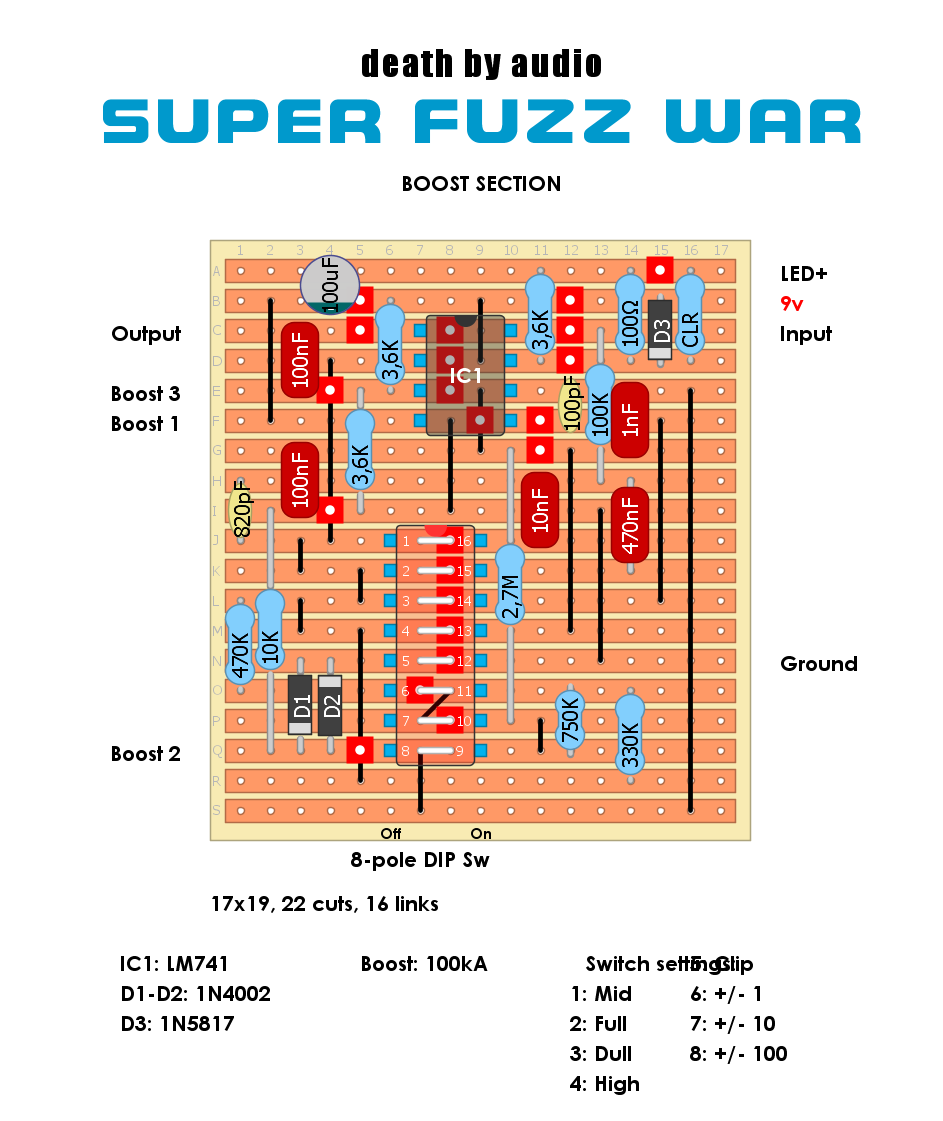
Fuzz section with suggested mods.


The Royal line of effects was made in Tokyo, Japan in the early 70s by Thunder Electronics. Not much is known about the company but they had some own designs in their portifolio along with the casual Shin Ei superfuzz clone.
Royal RC-1 Effect Machine was an inductorless wah which topology was based on fuzz face and a twin notch filter. It is not the most powerful or vocal wah but it does a decent job after a superfuzz just like in Royal RFC-1 Double Effect Machine.
The layout and schematic is verified.


The last mojo layout for a while. This one isn't one of the classics, quite the opposite. It isne of the rarest vintage fuzzes out there and for the longest time noone knew what the circuit was like until Deadend Fx managed to trace it a couple of years ago. It is a quite heavy affair, especially when the larger input caps is selected. Fairly low gain NPN silicon transistors is recommended, in the 100-150 Hfe range.
Compact layout avaiable HERE.

It is all about the MOJO! Got a comission to build a bunch of the larger classic fuzz circuits using "mojo" parts, more preciely 1/2w carbon composition resistors and axial electrolyctics/tantalums. It may not be a huge difference soundwise but it is quite fun to build and it looks cool.:-p.
Power filter caps remains radial as well as the film caps but for true MOJO, tropical fish or mustard caps should be used:-). But I will probably end up with Greenies or ceramics. Also, all transistor pinouts will be CBE but if I manage to source some of the harder to find transistors with BCE pinouts, I will do some leg twisting. Note that none of these layouts is verified at the moment and I will start building most of the stuff in a couple of weeks but if anyone fancy building it now...here you go!
First up....Fender Blender.
Compact layout avaiable HERE.

A simple but heavy germanium fuzz using PNP transistors with normal power supply. What not to like?
The original used fairly high gain OC76 cans but others with less gain will work as well. Just keep the leakage reasonable low when selecting the transistors.
Two layout for this, one normal compact and one MOJO with 0,5w carbon comp resistors and axial electrolyctics.


Schematic avaiable at PedalPCB.
Did one tiny mod; replaced the drain resistor of Q4 (20k) with a trimpot for easier biasing.

Another old octave down circuit with a forest of transistors.... It also have a rare part, MFC-4040 which were a 4.pin divider/flip-flop IC. It went obsoltete in 1975 but according to several sources, NTE754 is a direct replacement. R12 and C21 is marked as "factory tailored component" in the factory schematic so these needs to be socketed and tested. And yes, there is a 1,4uF cap under Q4 but a 1,5uF will do.

Here is one for the Psychocandy fans. Just put this after your superfuzz clone (or to be more accurate, your "6TR" superfuzz clone) and go to town. The stock transformer part number is unknown but a 42TM013 will do with its 500mH inductance. Both 50k and 100k wah pots were used and input cap were iether 50nF or 10uF.
Schematic avaiable at Tonehome.

Here is an old odd cat. This is an all discrete clean monophonic octave down effect made by Shin Ei back in the early 70s. Initially I though this was a Maestro OB-1 clone but the schematics revealed that's not the case.
See the notes below the layout for components that needs matching for best result. And I must admit the switching is a bit confusing but I think I got it right. Also worth mentiong is that reducing the horizontal cap right to Q11 will give a more aggressive and louder octave down signal.
It was sold under several brand names like Pax, Rands and Sekova. Colorsound also made their own version called Octivider but it had a quite few value changes so that one deserves an own post.
*Update 240120* Verified by JRuss with a small correction. Pinout of Q77 altered to match the schematic.